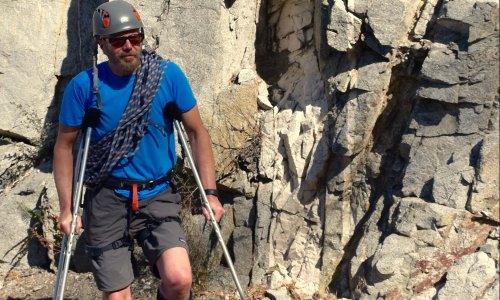
 Jeff Archibald
Should you bike, lift, run, yoga, Pilates, swim or just stretch?
The simple answer is definitely yes… you should do a variety of these activities on a regular basis. But, of course, life is not that simple. So, the obvious answer is… no, don’t do all of them with ‘vigor’ all the time. And, of course again, you know of that one guy who gets up at 5:00 am and then walks on his hands two miles to the gym to squat 500lbs before running ten miles to go work on his farm all day… there is always ‘that guy’. However, next year I am certain I will see ‘that guy’ at my physical therapist’s office. I was sort of ‘that guy’ back during the Flintstone era.
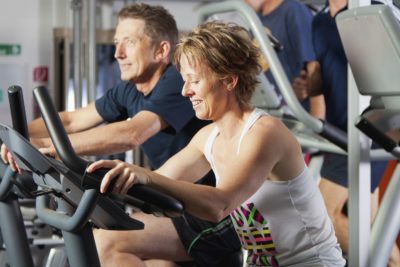
In the gym © zstockphotos 123rf.com
Today, there seems to be unlimited ways to get in ‘great shape’. I assume a majority of us over the age 35 are now aware of the need to do more than just one type of exercise to keep the wheels aligned properly. Important note: If anyone still believes that all they need to do is yoga or swimming or running or (fill in the blank with incomplete exercise here), then (and I do not mean to be contradictory or haughty) they seriously need to Google some research articles on ‘Pattern Overload’ to find out what will be the long term result of any particular exercise endeavor. There are plenty of people who can get away with just yoga for a very long time; and, to the average person they may seem quite ‘fit’. However, good luck to those older yogis picking up that heavy suitcase and loading it on that high airport bus rack injury free.
Please understand there is nothing wrong with yoga or any non-extreme exercise. Yoga is great. I suggest all of my ‘joint healthy’ clients do some level 1- 2 basic yoga on a regular basis. I just use yoga as a prime example because I live in Los Angeles and it is a pervasive argued theme in the ‘uneducated fitness world’ here (important note – your general doctor and even your orthopedic surgeon are probably one of the most fitness uneducated). Yoga, weight machines, treadmills, elliptical machines, etc. have helped to create a whole genre of middle aged men & women with healthy FAS (Flat Ass Syndrome). Healthy on the inside (and everything looks great in clothes), yet don’t wear tight bathing suits in public or pick up anything that weighs more than 50% of your body weight.

Yoga by the sea © szefei 123rf.com
The free weight room is incomplete too. Like choosing ingredients for a well balanced meal at the grocery store, real ‘comprehensive fitness’ has many correct combinations and none of them are a more perfect combination of ingredients than another. The more variety one has over time (not all at once), the more functional benefit the long term fitness regimen should be for both performance and injury prevention.
Now the hard part… What should you do? The answer is…
Periodization Training
For all of us outdoor junkies, spending hours and hours, month after month on the mtn or road bike and/or run-hiking the trails is our ‘enjoyable’ solo endeavor. And, I bet most of you are super busy and so squeezing in a quick bike/hike/run is your only mental freedom from your non-stop ‘important shit I have to do today list’. Then by all means… don’t worry about the gym in the ‘short term’. Now, let’s take one more tangent moment….
The most important primary muscle for always and forever is the one between the ears.
If your omnipotent-emotional-thinking-action-creation muscle feels any major negative strain, then just the simple attempt to start any endeavor (ie just the thought of walking into a gym) becomes the crucial hindrance to your desired outcome (aka “I don’t wanna do that!”). This 3 lb. muscle of grey matter probably needs to be primarily well rested and probably ‘motivationally therapy-ized’ first. If it truly despises any exercise… then all those other muscles it controls will eventually end up not doing that exercise either; or, will be doing the exercise half-assed which leads to getting themselves into future trouble by developing faulty negative muscle recruitment patterns.
However, the good news is I have found that with a lot of ‘exercise foreplay’ this emotionally uptight antagonistic hamstring of the hippocampus can become flexible enough to enjoy almost any challenging endeavor (more on this subject in future articles).
Periodization Training in Regards to Biking
The average distance between the pedals on any bike is @ 12 inches. So, the feet are only going to be about a foot apart the entire time one is pedaling into the horizon (or til the end of The Bachelor at the gym). The static position of the body is forward flexion (even on a recumbent bike): The femurs are also being repeatedly pulled up (aka hip flexion) to make the feet go round & round. To balance this equation it may seem logical to counteract a hip-flexing habit with equal amounts of extension. This is not the best idea as it does little to reduce the excessive amount of activated tension in the psoas muscle (if you do not know of the psoas = time to Google)… it just overrides it temporarily. Instead of adding extension exercises, look to exchange hip flexion activities with hiking or even just walking; endeavors that require more ‘active’ hip extension. Sitting at a desk or in any seat (including your vehicle) is a long term static hip flexion posture. Now, add a ton of enthusiastic cycling and presto… enjoy your future of SI dysfunction and psoas length-tension issues (Google time).

The Great Outdoors ©Blazej Lyujak 123rf.com
Reducing sitting time with a standing workstation, and try to limit seated type exercises (ie bikes & weight machines). Do add a variety of psoas stretches (Google) and anterior hip lengthening exercises like warrior and lunge pose (yes, yoga). Important Note: Pay attention to the ‘rib thrust’. Rib thrusting (aka not bracing the core) during hip extension stretches reduces the effectiveness in lengthening the psoas. Contract the bottom of your rib cage (abs & obliques) until they line up with the pelvis; and, try to limit lumbar flexion… aka don’t crunch your lower back while in these positions.
The human body can be remarkably efficient. To protect itself from unwanted injury the body will automatically sequence the recruitment of muscles to provide load sharing across as many muscles and joints as possible. This allows each working muscle to make its maximum contribution when most favorable with regard to optimal length/force and length/tension relationships. However, if one of the muscles (especially a primary stabilizing muscle like the psoas) is injured/over-used it will inhibit any load sharing across it’s spectrum of action (aka it won’t do any work and will just lock down in short mode). This inhibition will send the load forces back in either direction and possibly cause over-load to the corresponding joints of action. Continuing to perform exercises which load the same tissues that were insulted during exercise or extended static body positions (ie 5 hours trapped in Southwest Air economy seating) will only serve to reflexively inhibit local stabilizers and will eventually encourage a pattern overload.
Functional Training to Prevent Pattern Overload
Functional exercises require maintenance of your center of gravity over your base of support. As the base of support and stability is reduced, the number of muscles necessary to perform a movement increases. As the number of working muscles increases, so too does the demand for neurological energy (the greater the demand the faster the central nervous system fatigues).
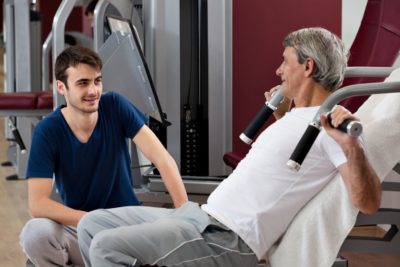
Working on technique © fotomircea 123rf.com
Important Note: Exercising on weight machines with poor technique and/or overuses in any form of guided resistance (ie eliptical machines), the resultant fatigue and loss of motor control in the relevant movement pattern and plane of movement often leads to overload of the passive joint structures. Being predominantly collagen, these structures do not stretch well and do not bounce back well from repeated stretch either. The analogy is pulling a rubber band to its full length repeatedly… it becomes slack and no longer holds the papers…. kind of what happens when the joint capsule and/or ligaments are stretched in your body. A joint with lengthened structures and stretched articular ligaments begins to lose its capacity to stabilize and eventually tries to fall out in positions specific to the developed dysfunction (ie dislocating a shoulder while throwing and slipping a lumbar disk with excessive forward bending in yoga class).
In regards to biking, pattern overload is a very common but frequently overlooked source of musculoskeletal injury; and, greatly increases potential injury when transitioning to another endeavor. To reduce this chance of injury, periodize the use of bicycles, weight machines and any activity that requires repeated specific movement patterns. The stabilizer system of the body should always be capable of handling the repetition of any movement pattern; especially it if it is going to be performed with excessive duration and/or intensity. Pay attention to the selection of exercises and their order (don’t do heavy calf raises if you are planning a hard hike/run the next day). Anyone suffering from pattern overload should seek an orthopedic rehabilitation center and/or get advice from a ‘qualified’ fitness professional (my advice – don’t go hire the cheapest trainer at 24 Hour Fitness).
Article by: Jeff Archibald

Jeff Archibald
Jeff Archibald, NASM-OES, ACE-CES
ACE & NASM Fitness Trainer
Orthopedic Exercise Specialist
Corrective Exercise Specialist
310 890 6783
Jeff@BOLDFITNESS.com
www.BOLDFITNESS.com
http://www.yelp.com/biz/boldfitness-west-los-angeles
www.facebook.com/JEFFARCHIBALDBOLDFITNESS