[Kevin Raleigh note: Kurt Bestor is a friend, client, avid outdoorsman and Utah music god. I’m honored to have him be Rocking Outdoors’ first featured musician who also loves the outdoors.]
Climbing Kilimanjaro
Our Highest Thoughts – Rock Written
(Terry Tempest Williams – from the libretto of Kurt Bestor’s orchestral tone poem “Timpanogos:A Prayer for Mountain Grace”)
I remember always being enamored of mountains which is kind of odd for a kid from Wisconsin, a state overflowing with cheese, bratwurst, yodeling, and anything Packers, but lacking anything that could be called a mountain. However, a job move for my father when I was eight took the Bestor family in our over-stuffed Buick Safari station wagon across the mind-numbing flatness of Iowa and endless corn fields of Nebraska through the blustery plains of Wyoming until reaching our destination – Provo, Utah. Our thoughts, as we gazed upon the snowcapped Wasatch Mountains echoed those of the leader of the Mormon pioneers as he beheld the the same vista 150 years before “This is the place.” And it was “the place” – the place where I skied, camped, hiked, meditated and dreamed of climbing higher and more exotic peaks. Eventually, that dream took me over 9000 miles away to Arusha, Tanzania and the foot of the iconic African mountain, Kilimanjaro.

Mount Kilimanjaro
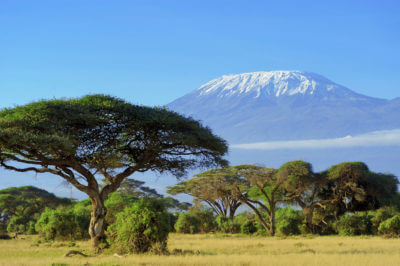
The first thing you notice as you gaze upon the highest mountain on the african continent is that it is not only impressively tall (19,341 feet) but it is singularly alone. Most mountain peaks, whether they inhabit the Himalayan region of Asia, the Alps of Europe, or the Rocky Mountain region of North America, are part of earthquake-produced mountain ranges. Kilimanjaro, on the other hand, is the “big volcano that could” and stands majestically all alone, usually enveloped in a shroud of white clouds. The name of the mountain is also shrouded in a little mystery as to its origins. One theory is that the name is a mix of the Swahili word Kilima, meaning “mountain,” and the KiChagga word Njaro, loosely translated as “whiteness.” Another is that Kilimanjaro is the European pronunciation of a KiChagga phrase meaning “we failed to climb it.” My group of eight hikers were hoping that the second theory would be disproved and we would, after six days of climbing, discover the “whiteness” of the glacier that covered this epic mountain peak.
My wife, Petrina, who hails from nearby Kenya and who works for a high-end safari company (Royal African Safaris) had organized the entire trip (including the week-long Serengeti safari that would be our reward for conquering the peak.) Her expertise was evident on the very first day as we rounded a corner of our hike through the mountainous rain forest at about 6000 feet and there waiting for us was a fully-prepared meal set on a fancy linen-covered table complete with tea and biscuits. The other guided groups could only sigh as they walked by us munching their turkey jerky and trail mix. Of course, this royal treatment came with a price, but each night as our tents, sleeping bags, and clothing duffles awaited us after the day’s climb, it was definitely worth the price.
As we climbed, our extremely attentive guides and porters would continually remind us to drink plenty of water. “Clear and copious” was their mantra as they knew that most people who don’t reach the summit are victims of altitude-related issues and water was one of the keys to avoiding them. They would also greet us with a phrase in Swahili “po-le po-le” which means, “slowly slowly.” Being in good shape, I was, at first, a little irritated at the pace they made us march. But, after awhile, I could see their wisdom in those two words and besides, there was so much to take in on this incredible hike.

Hiking up Kilimanjaro
Kilimanjaro encompasses a wide variety of ecosystems, including tropical jungle, savannah, and desert to montane forests, subalpine plants, and the alpine zone above timberline. Since we were in East Africa, the “bread basket” of animals, I was expecting to see many more creatures than we did. However, it was explained to me that since Kilimanjaro has no bamboo zone, there is not enough food to sustain all the animals found in other parts of East Africa. That said, we still were accompanied on our hike by a cacophony of birds and monkeys. And the midnight screeching of the colobus monkeys, tree hyrax, and bush babies would rival any episode of “The Living Dead.”

Kurt on the trail
Our route was the Machame route which we chose in order to maximize acclimatization. Though a few days longer than the more-frequented Coca Cola route, we wanted to be sure that our entire group summited. For the most part, besides a few blisters and sore quads, I felt great each night until about 15,000 feet when I began to experience pretty strong headaches. Repeating to myself the phrase “copious and clear” I practically drank my body weight in water and the pounding in my head became much more tolerable. I remember as we started the trek from 15,000 to 16,500 feet, trudging past the gigantic skull of an elephant. Our guide looked at me, chuckled and said, “This is where Mzee’s come to die.” (Mzee is “old man” in Swahili”)
There is only one area on our route where we used a rope to aid our descent and where we donned hard hats to protect from scree and loose rock falls. Even on this steep 45 degree climb, our ever-smiling porters had prepared tea and sandwiches which they placed as delicately on a rock table as a butler in Buckingham Palace. A few more hours after this welcome lunch, we reached the glacier at 18,000 feet. We had been told that it was minuscule compared to what it had been decades before global warming having taken its toll. But we were still dwarfed by the 70-foot walls of snow and ice and wondered what it would be like to slalom down these snowpacks. This flat glacier plateau was to be where we would spent our final night before submitting the following morning.

Sleeping on Kilimanjaro Photo: Andriy Babets / 123rf.com
Sleeping had been getting progressively worse from camp to camp. But this final night spent with chattering teeth and an aching “clear and copious” bladder was miserable. However, we fared much better than a Frenchman in a tent a few hundred yards away who, upon wandering out of his tent in nothing but his knickers and French flag tattoo, was found to have cerebral edema and was immediately evacuated to 10,000 feet. Our head guide, Victor, told us that it wasn’t always the most athletic and fit hikers that reached the top. Genetics and ones environment played a big part. I was counting on my hearty Swiss genes to kick in the next morning as we hiked “po-le po-le” to the summit.
I know it’s a far cry from an Everest or K2 hike, but that final 1000 feet spent zig-zagging to the top, no one saying a word but just slowly placing one foot ahead of the other, zapped our energy quickly. We didn’t really look up much but when we did, Kili’s summit was in spitting distance. But I’ll be damned if it didn’t take 2 hours to finally stand there at the top. But stand there we all did except one of our mates, Paul, who – unbeknownst to the group – had hidden the fact that his doctor advised him not to attempt the hike due to a bad heart and he had turned back at 15,000 feet.
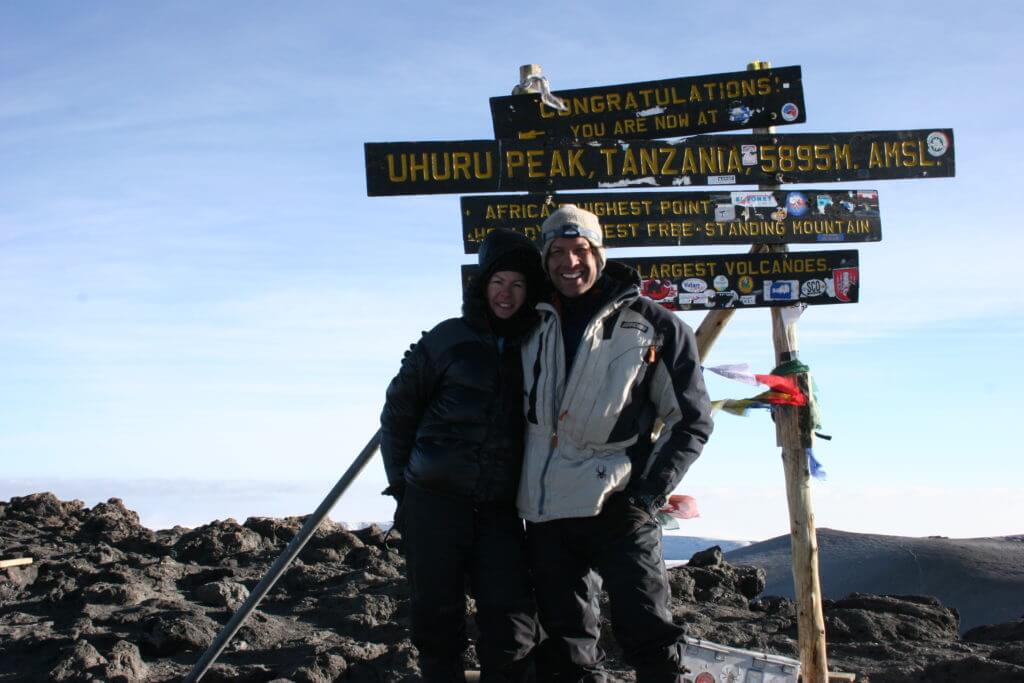
At the top of Africa
While it had taken us six arduous days to trek this magnificent African peak, we descended like horses to the barn in less than 8 hours. Though not a beer drinker, an ice-cold bottle of the local Kilimanjaro beer sipped while being entertained by our dancing and singing guides and porters, was just about perfect.
While the next seven days were spent in safari vehicles in the Serengeti leisurely snapping photos of flora and fauna, I couldn’t help turning around every so often to glance at the mountain that had etched it’s place into this adventurer’s heart.
Article and photos (except as noted): Kurt Bestor
KURT BESTOR
 Kurt Bestor is an Emmy-award-winning and Grammy-nominated composer who, for almost 40 years, has composed and arranged music in a myriad of styles and genres. His accomplishments include over 30 feature-length films, 18 popular albums, numerous national television themes, and a mix of live shows and commissioned works for choirs and orchestras.
Bestor has also performed internationally, conducting and performing with the Royal Liverpool Philharmonic Orchestra and Choir and the Estonian National Orchestra, among others. He recently completed a commissioned composition (by AFCO’s Craig Jessop), which is a 5-movement work for choir, brass, woodwinds, percussion, and 2 piano, titled “John F. Kennedy: Rise, Fall, and Immortality.” It was premiered at the ACDA Convention in Dallas to celebrate the 50th Anniversary of Kennedy’s assassination.
Bestor makes his home in Salt Lake City with his wife Petrina and daughter Ella, where they spend much time hiking, skiing, and camping in the picturesque mountains surrounding his home.
www.kurtbestor.com